Sunday, June 19, 2011

Best. Ride. Ever.

In the fall of 1966 guests were welcomed to Disneyland's newest addition, New Orleans Square. Having been under construction since 1961, guests were anxious to see the new land. New Orleans Square would add three acres to the park that would include attractions, shopping, and restaurants. Set within several winding streets, guests were invited to board boats and travel to the Caribbean in search of pirates, enjoy authentic southern cooking, and shop for fine gifts and souvenirs. The small streets were immersive and encouraged guests to slow down and take their time as they walked and window shopped. Jazz musicians played from the street corners, setting the mood. As the guests found their way through the town and to the end the street, they came into view of the Rivers of America, and watched as the Mark Twain Riverboat sailed by. It might be at this point that their gaze came upon the last part of the new land, a stately antebellum mansion just a short walk from the shops. It's classic southern architecture fit perfectly with the feel and excitement of New Orleans, and yet somehow seemed a bit different. It felt distant from the square and crowds. It stood tall, quiet, and alone. Only when guests walked closer did they notice the sign posted in front of the mansion's locked iron gates. It read, “Notice! All ghosts and restless spirits: Post lifetime leases are now available in this HAUNTED MANSION.”

Opening Day
This sign was the public's first introduction to Disney's Haunted Mansion attraction. It remained in front of the Mansion for three more years, building anticipation, before it's gates finally opened in August of 1969. When the public was allowed inside, they discovered stretching rooms, endless hallways, seances, and countless “happy haunts.” The rides popularity was immediate and within a week of it's opening, record size crowds were recorded at Disneyland. [1] The Haunted Mansion had been in Disneyland's plans since it's opening, but was almost never built. Originally slated to be at the end of Main Street U.S.A., it was removed in the early stages of the parks development, but not forgotten. Other locations were considered but it wasn't until Walt Disney decided to add New Orleans Square that the attraction finally found a home. Plans were suggested to for a dilapidated old home that would house a walk through attraction. Walt wasn't too keen on the idea of a deteriorating home detracting from his meticulously kept park and quickly put his foot down saying that, “we'll take care of the outside and let the ghosts take care of the inside.” [2] Construction on the exterior building was completed by 1963 and Walt's Imagineers quickly went to work laying out various stories and ideas for the interior, but struggled with how to manage large crowds in a walk through scenario. Further delays in it's progress came when Walt and his team accepted offers to design pavilions for the 1964 World's Fair that required all of their time and resources. In 1965 the team again focused on the Mansion using ideas they had learned from the fair. Most important was the use of the “Omnimover” system, a continuous chain of moving, swiveling pods that would take guests through a ride and direct their view. This solved the crowd control issues and gave the Imagineers a stage to develop their story for the ride. Progress accelerated with two separate schools of thought for the story and layout. Some Imagineers felt that the ride should be more serious and focus on staging and spooky effects while others felt it important to be whimsical and family friendly. Unfortunately, with Walt Disney's death in 1966, the team lost their guiding force and the one man who could break the tie. Competition for which direction to take the attraction delayed it's opening for several more years. Finally a compromise was made between the two sides with the first half of the ride being slow and ominous, and second half with friendly ghosts appearing near the end.

Imagineer Yale Gracey with Ghost
In my opinion, the Haunted Mansion is the epitome of a classic Disneyland attraction. The Imagineers were at the peak of their creativity when they designed the attraction and within the Mansion they pulled together every trick they had learned over the years. While it was not ground breaking in terms of new technology or animatronics, it did set a new bar for the level of immersive theming that I admire Disneyland for. While other attraction ask you to personally assume a new role or identity, such as a pirate or astronaut, the Mansion asks you to only be yourself. It is the ride that makes the transformation. By outward appearances the Mansion is nothing unusual. Even within the first few rooms of the ride, things are not out of the ordinary. But as you ride your surroundings slowly change, the music alters it's tone, and you find yourself face to face with ghosts and poltergeists. By the time you reach the final climactic scene, a graveyard filled with singing ghosts from around the world, you accept their reality without question. The ghosts even claim that they will haunt you until you return, and that is exactly what they do to me. I am fascinated with the ride's story, history, layout, and design. It is the best ride ever.
"And a ghost will follow you home!"


1. Surrel, Jason. 2003. The Haunted Mansion: From Magic to the Movies. New York, NY: Welcome Enterprises, Inc.
2. Surrel, Jason. 2003. The Haunted Mansion: From Magic to the Movies. New York, NY: Welcome Enterprises, Inc.

Tuesday, June 14, 2011

Discussing Disneyland

Main Street U.S.A.

Neal Gabler writes in his biography of Walt Disney that Disney “had been not so much a master of fun or irreverence or innocence or even wholesomeness. He had been a master of order.” [1] Nowhere is this order more evident in Disney's work than in Disneyland. As soon as guests enter his park they are greeted with Main Street U.S.A., an idealistic recreation of a small town at the turn of the century. While Main Street may at first appear to be modeled after an actual town, it is in fact entirely fictional. Beth Dunlop writes that “the buildings on Main Street are recognizable as archetypes but they aren’t authentic. They were drawn the way a town in a picture book or an animated film might be and then transformed into three-dimensional entities.” [2] While real sources were used for inspiration, Robert Nueman writes that “the designers were illustrators and continuity sketch artists formerly working at other movie studios.” [3] As such, they approached the design of Main Street as if they were building a movie set. Nueman writes that “the creators of Main Street took a cue from the set designer, who emphasizes certain elements. . .to give a more accurate impression, and heighten textures for the sake of contrast.” [4] Walt's designers removed the negative aspects of Main Street, such as the traffic and clutter, and created the impression of a nostalgic town that would set visitors at ease and invoke the charm and polite manners associated with this idyllic past. Christopher Finch writes that “Main Street was calculated to correspond with one of the archetypes of the American imagination, establishing an ambience that would put visitors in an appropriate frame of mind.” [5] Nueman adds to this idea writing that “Disney's designers rearranged the particularities of the small-town street to produce an idealized version of a Main Street that never existed in order to evoke nostalgia and encourage strolling and shopping.” [6]

Main Street U.S.A.
These innovations have placed Main Street in the forefront of design and planning. Dunlop writes that historian Richard V. Francaviglia believed that “Disney's Main Street in one of the most successful pedestrian environments in the world,” calling it “a remarkably effective design for reinforcing experiences, heightening anticipations, and moving traffic.” [7] Nueman also remarks that “Disneyland's Main Street deserves ongoing analysis because of its perceived status as one of the most successfully designed streetscapes in human history and its extraordinary impact on urban planning and the preservation movement over the last half century.” [8]

Disneyland Ticket Prices
These ideas of order and control continue throughout the park. Finch writes that Disneyland has “a sense of structure and continuity that was new to this kind of enterprise. . .every element had been thoughtfully considered and imaginatively developed.” [9] There are, however, less supportive views of the complete control and order that exists in the park. Alan Bryman voices his concern that Disneyland exercises it's control before guests even enter the park. He writes that Disneyland “has a further method of control in the form of the relatively high cost of admission which ensures that only visitors with appropriate characteristics – ones that are unlikely to be a source of problems- gain entry.” [10] He voices his concern with Disney's control inside the park as well. He argues that “movement is simultaneously maintained and constrained by what Walt referred to as 'wienies', visible lures which draw people on to the next attraction in one of a number of predetermined sequences. In this way, the visitor's movement is both overtly and covertly controlled by that park's physical layout and by its inbuilt narratives. The opportunity to cross 'lands' is highly restricted so that the integrity of their themes can be maintained.” [11] Bryman continues his argument stating that “a further element of control is in the attractions themselves. Rather that allowing people to move around freely. . .the visitor rides in a car. This means that each person will only spend a few moment gazing that the scenes and objects that the Imagineers have created. As a result, Disney can control the amount of time that each person expends on the attraction so that large numbers of people can be allowed access to it.” [12] Bryman believes that this order created by Disney's designers has negative results. He writes that “the high level of control has brought the accusation from some commentators that Disney theme park visitors become passive.” [13] Bryman concedes, however, that “some writers have noticed that the high level of control exercised at the Disney parks is very attractive to many visitors.” [14]

  1. Gabler, Neal. 2006. Walt Disney: The Triumph of the American Imagination. New York City, NY: Alfred A. Knoff
  2. Dunlop, Beth. 1996. Building a Dream: The Art of Disney Architecture. New York, NY: Harry N. Abrams, Inc.
  1. Neuman, Robert. 2011. Disneyland's Main Street, U.S.A., and Its Sources in Hollywood, U.S.A. In Disneyland and Culture: Essays on the Parks and Their Influence, ed. Kathy Merlock Jackson and Mark I. West, 37-58. Jefferson, NC: McFarland and Company, Inc.
  2. Neuman, Robert. 2011. Disneyland's Main Street, U.S.A., and Its Sources in Hollywood, U.S.A. In Disneyland and Culture: Essays on the Parks and Their Influence, ed. Kathy Merlock Jackson and Mark I. West, 37-58. Jefferson, NC: McFarland and Company, Inc.
  3. Finch, Christopher. 1995. The Art of Walt Disney: From Mickey Mouse to the Magic Kingdoms. New York, NY: Harry N. Abrams, Inc.
  4. Neuman, Robert. 2011. Disneyland's Main Street, U.S.A., and Its Sources in Hollywood, U.S.A. In Disneyland and Culture: Essays on the Parks and Their Influence, ed. Kathy Merlock Jackson and Mark I. West, 37-58. Jefferson, NC: McFarland and Company, Inc.
  5. Dunlop, Beth. 1996. Building a Dream: The Art of Disney Architecture. New York, NY: Harry N. Abrams, Inc.
  6. Neuman, Robert. 2011. Disneyland's Main Street, U.S.A., and Its Sources in Hollywood, U.S.A. In Disneyland and Culture: Essays on the Parks and Their Influence, ed. Kathy Merlock Jackson and Mark I. West, 37-58. Jefferson, NC: McFarland and Company, Inc.
  7. Finch, Christopher. 1995. The Art of Walt Disney: From Mickey Mouse to the Magic Kingdoms. New York, NY: Harry N. Abrams, Inc.
  8. Bryman, Alan. 2004. The Disneyization of Society. London, Thousand Oaks, New Delhi: Sage Publishers.
  9. Bryman, Alan. 1995. Disney and His Worlds. London and New York: Routledge.
  10. Bryman, Alan. 1995. Disney and His Worlds. London and New York: Routledge.
  11. Bryman, Alan. 1995. Disney and His Worlds. London and New York: Routledge.
  12. Bryman, Alan. 1995. Disney and His Worlds. London and New York: Routledge.

Tuesday, June 7, 2011

Disneyland's Contribution

On the surface, Disneyland is nothing more than an amusement park. It is simply a collection of rides and attractions. In fact, if we were to remove the facades and decorations that adorn the park, we would find that the rides are arguably common. Boat rides, roller coasters, carousels, and dark rides can be found in amusement parks across the country. More than that, when Disney brought these rides into their park, they often did little to alter them mechanically. While other parks strive to push the limits of their rides, designing them to be faster and more thrilling than the last, Disney is content with rides that are comparably tame. Their dinning and shopping offerings are, at their core, also remarkably plain. The restaurants offer quality food, but the menus are not dramatically different than anything available outside the park. Their stores differ only in the fact that they exclusively sell Disney products, but not necessarily exclusive products. So why is Disneyland important? Why do millions of visitors come to the park each year, at considerable cost, making it one of the most popular parks in the country (topped only by Disney World)? [1] Why should we care about Disneyland?

Disneyland Tour Guide Costume
When Walt Disney built his park, he wanted it to be the finest park that families could visit. He wanted it to be clean, safe, and inviting. After researching other amusement parks hoping to find ideas and being disappointed with what he found, he set out with a team of artists from his studio to design his park from scratch. Relying on their background in film and animation, Walt and his team designed Disneyland as if they were creating a set for a movie. With this approach, it was natural for them to focus on the appearance of the park first. They strove to hide any required structural elements of the park, such as the large buildings that house their attractions, with themed facades. From there, they dressed their employees in appropriate costumes for the locations they were working in. Every detail was planned and nothing was left to chance. All of this came together to create a visually immersive stage that would allow their visitors to live out their fantasies. They had perfected the art of theming. Their planning, however, was not limited to just the appearance of the park. Margaret King wrote: “In the theme parks, Disney's Imagineering design team pioneered the total-control governance of utilities and building process. . . Disney organized crowd behavior in the form of switchback lines to minimize the feel of waiting in line, the pedestrian mall and the psychology of way-finding . . . and the concept of “guests” rather than visitors or customers.” [2] All of these ideas were implemented to enhance guest's experience in the park and make them feel part of Disneyland. This idea of theming, with the concepts of controlling the environment and customer service being a integral part of it, set Disneyland apart from any park before it and became the foundation of the “magic” of the park. As the park has proved successful over the years, these tactics have become commonplace in business and have been applied by many companies. King continues to write, “The techniques perfected at Disneyland are featured in banks (line theory), food courts (theming), museums (total immersion exhibits), and customer service (“guestology training).” [3]

The Mayan Adventure interior
Locally, The Mayan Adventure, a Mexican restaurant in Sandy, is a perfect example of how the use of the theming pioneered by Disney has become popular. While their menu is filled with common Mexican dishes, the appeal of the restaurant is it's “show.” Decorated to resemble a large Mayan temple, the restaurant features animatronic birds, tropical foliage, waterfalls, and even performing cliff divers. It follows Disney's example of taking a common activity and magnifying it with elaborate theming to create an “experience” rather than just a meal. Gardener Village, a shopping complex in West Jordan, is another example of theming, this time to create a shopping “experience”. Consisting of a few walkways lined with small houses, each of which contains a separate store, it recreates the feeling of a quaint, old village to attract its customers.

While Disneyland was certainly not the first amusement park, it's creation of theming was revolutionary and became it's contribution to society. The park has become a testing ground for the practice of these new ideas in customer service, customer interaction, and marketing and continues to influence businesses of all types.
  1. Kevin Downey, “Travel Trends: Theme park attendance down, Disney remains strong <http://www.gadling.com/2010/06/16/theme-park-attendance-down-disney-remains-strong/> (accessed March 6, 2011).
  2. Margaret J. King, “The Disney Effect”, Disneyland and Culture, (2011): 223-226.
  3. Margaret J. King, “The Disney Effect”, Disneyland and Culture, (2011): 223-226.

Tuesday, May 31, 2011

Why I like Disneyland

In the fall of 1998, a good friend of mine, Brad, called and asked if I wanted to go on a vacation. I told Brad that I would be happy to come along, depending on where he wanted to go. Brad told me that he wanted to go to California. I said that California sounded great. He told me that he wanted to spend a week in Disneyland. I wasn't so sure about that. I hadn't been to Disneyland since I was five years old. I had fond memories of going, but thought I was too old to go back and it seemed like a long time to stay at an amusement park. Brad argued that it would be fun and we needed the whole week. Since he was planning the trip, I figured if he wanted to spend five days in the park, then so be it. We enlisted two other friends, Sam and Dylan, made the arrangements and hopped on a plane to southern California. We took a bus from the airport to our hotel, checked in, dropped off our luggage, and walked across the street to the park.

At the entrance to Disneyland all that is visible of the park is the Main Street Train Station. The station and its tracks sit atop a high berm that surrounds the park, keeping the attractions out of view from the surrounding city. After coming through the turnstiles at the entrance, you walk through a tunnel under the train tracks, and emerge on Main Street USA, a recreation of a small American town in the early 1900s. Various shops, an arcade, movie theater, ice cream parlor, and bakeries line the street that leads into the heart of the park. At the end of the street stands Sleeping Beauty's Castle, a sign of the fantasy that is Disneyland. This was our introduction to Disneyland, and to be honest, we weren't sure what to make of it.

Temple of the Forbidden Eye
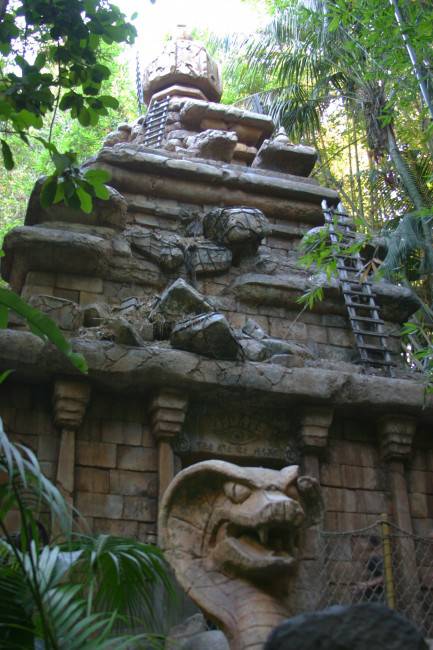
Brad quickly led us down Main Street and directed us to our left, through the gates of Adventureland. As we walked under the bamboo entrance adorned with spears, skulls, and wooden tiki gods, we watched as the landscaped morphed into an exotic jungle. The victorian architecture of Main Street became mud buildings with thatched grass roofs. In place of bakeries we found shops to outfit expeditions. Instead of gas lamps lining the street, we found torches. Brad took us directly to the Indiana Jones ride. Its line started at a camp that was strewn with crates of supplies, cargo trucks, and artifacts. We walked through the camp and soon entered the large, stepped pyramid that is the Temple of the Forbidden Eye. We followed the path through the entrance of the temple into underground caves and ancient ruins. Eventually we emerged from the caves and found ourselves in an archeological dig within the center of the temple. It was here that we learned the history of the temple and that it was rumored to have treasures within, and that we were going to search for them. We boarded a jeep and drove into the dark tunnels of the temple and were met with an adventure that none of us expected. We exited the ride and followed a similar path out of the attraction and again found ourselves in Adventureland. We stood there and looked at each other for only a moment before we ran back down the line to ride a second time. And then a third. Each time we ran through the line, into the temple, through the caves and onto the ride, we became more and more enamored with the experience. After the third time we came out feeling like adventurers, not just guests in a park, and our attitude about Disneyland had changed.

Myself and Brad
Over the next four days, Disneyland continued to weave its magic on us. We traveled through time to visit both the future and the past. We became a part of the American frontier riding trains, canoes, and riverboats. We visited haunted mansions and narrowly escaped from murderous pirates. We visited cartoons in their home town, talked to animals, and traveled in space. We even took a bobsled ride down a Swiss mountain. It sounds ridiculous, doesn't it? We ran around like little kids without a care in the world. We had the time of our lives.

Dylan and Sam
This is what I find so fascinating about Disneyland. It has the uncanny ability to free you from your cares and let your imagination run free. It can set your inhibitions aside and let you feel like a kid again. It lets strangers become friends. It creates a fantastic stage and makes you the main character in your own adventure. It is such an immersive experience that, if you allow it to do so, can convince you that it is real. We walked into Disneyland skeptical that we could spend five days in the park and left wishing that we had more time to stay.

Tuesday, May 24, 2011

How the Magic Began

Ronald Reagan hosts the
opening of Disneyland
On July 17, 1955, Disneyland was introduced to the world. With ABC broadcasting the event live, families across the country eagerly watched as Art Linkletter, Bob Cummings, and Ronald Reagan welcomed guests and celebrities, and guided television viewers throughout the park. This was the culmination of years of planning by Walt Disney. After struggling to find financing and support for his dream, twelve frantic months of construction, and countless hours of work, his park was finally realized. Sharon Baird, a mouseketeer, said, “I was standing next to him at the window, watching the guests come through the gates. When I looked up at him, he had his hands behind his back, a grin from ear to ear, and I could see a lump in his throat and a tear streaming down his cheek. He had realized his dream.”[1]

Walt Disney had been dreaming of a family park for years. His ideas began with his visits to Griffith Park in Los Angeles with his two young daughters. While watching them ride a carousel and paying attention to the conditions of the park, he noticed that the parents around him had nothing to do while their children played. He felt that there should be a clean and welcoming place where parents and children could have fun together. Originally his plans were to build a small play park on an eight acre plot of land across the street from the Disney Studio in Burbank. It was to have a few small rides, including a train that circled the property, and would be a place for families and visitors to the studio. As Walt began his research and visited other parks around the world, his ideas began to expand and his park quickly outgrew the original site.[2]

The Original Disneyland
Walt had the Stanford Research Institute conduct a survey to find a location for his park. He required 100 acres of land that he could shape with rivers, railroads, and rides. It needed to be close to a freeway, outside of the Los Angeles metropolitan area, and not overly expensive. The research eventually led to a 160 acre orange grove in Anaheim, California. Walt encountered difficulty finding the money he needed to purchase the land and begin building. He once said, “I could never convince the financiers that Disneyland was feasible, because dreams offer too little collateral.” As a result, Walt turned to television to find his support. In exchange for producing a weekly television series, “Walt Disney's Disneyland”, ABC agreed to provide funding for Disneyland. Construction began on July 21, 1954, just twelve months before opening day. [3]


On July 17, 1955, Walt Disney enthusiastically dedicated his new Disneyland park. It opened with five themed lands: Main Street USA, Adventureland, Frontierland, Fantasyland, and Tomorrowland. The opening day, however, did not go as planned. The invitation only event was over crowded. While 11,000 guests had been invited, over 28,000 people arrived, many with counterfeit tickets. It was an unusually hot day with the temperature rising to 101 degrees. Due to a plumbers strike during construction, drinking fountains were not working and concession stands quickly ran out of drinks. The asphalt was recently poured and still soft, causing ladies' high heels to sink into the blacktop. A gas leak forced the closing of three of the five lands in the park for most of the afternoon. Despite these complications however, people were in line as early as two am the next day, when the park opened to the public. Approximately 50,000 guests were in attendance that Monday.[5] The popularity and success of the park continued to grow and on September 8, 1955 the one millionth guest walked through the turnstile. [6]

The Matterhorn Bobsleds, Monorail
and Submarine Voyages
Disneyland continued to grow in the following years in both popularity and size. In 1959 the park saw the addition of several new rides including the popular Matterhorn Mountain Bobsleds, the first daily operating monorail system, and the Submarine Voyages. In 1964 Walt was asked to help in the creation of four attractions in the New York World's Fair. The work done for the fair included the creation of the “It's a Small World” attraction, which was brought to Disneyland after the fair, and the creation of an Audio-Animatronic Abraham Lincoln for the Illinois pavilion. These projects helped Disney tremendously, as he used the technology he developed for the fair in several new attractions in his largest expansion to Disneyland to date; New Orleans Square opened in 1966 and added 3 acres to the park. Included in the expansion were the Pirates of the Caribbean and Haunted Mansion rides. In 1967 a newly redesigned and updated Tomorrowland opened after a lengthy renovation. In 1972 a new land opened themed to a rustic forest and called Bear Country. 1977 brought the addition of Space Mountain, a high speed roller coaster inside a dark building, to Tomorrowland. Big Thunder Mountain, a railroad themed roller coaster, was added to Frontierland in 1979. In 1989 a flume ride themed to Disney's cartoon “Song of the South” was built in Bear Country and named Splash Mountain. In 1993 the newest “land” was added to the park, Mickey's Toontown, the city that cartoons built.[7]

Disneyland today
Today, 56 years later, Disneyland is still as popular as when it opened. It continues to be a place for children and parents to have fun together. It has inspired the creation of four other Disney parks around the world (with a fifth currently under construction) and has become a resort destination itself, with nearly 16 million guests each year. [8]


[1] “Disneyland 55 Years Strong,” Words From Skrach, 20 July 2010, <http://vividlyvintage.com/2010/07/> (23 May 2011)
[2] “Disneyland,” Wikipedia, 19 May 2011, <http://en.wikipedia.org/wiki/Disneyland> (23 May 2011)
[3] “Disneyland's History,” JustDisney.com, <http://www.justdisney.com/disneyland/history.html> (23 May 2011)
[4] “Disneyland Dedication” [Video] Retrieved 23 May 2011 from http://www.youtube.com/watch?v=6W8iiugY3C0.
[5] “Disneyland,” Wikipedia, 19 May 2011, <http://en.wikipedia.org/wiki/Disneyland> (23 May 2011)
[6] “Yearly Attendance Figures of All Disney Theme Parks 1991-2009,” The Disneyland Linkage, <http://www.scottware.com.au/theme/feature/atend_disparks.htm> (23 May 2011)
[7] “The JustDisney.com Disneyland Timeline,” JustDisney.com, <http://www.justdisney.com/disneyland/timeline/index.html> (23 May 2011)
[8] “Disneyland,” Wikipedia, 19 May 2011, <http://en.wikipedia.org/wiki/Disneyland> (23 May 2011)